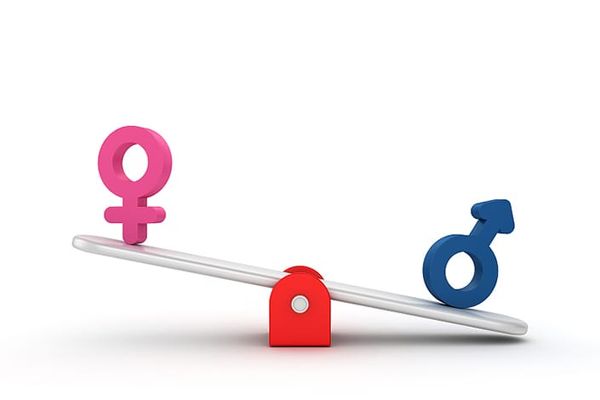
The Structural Logic of Gender Hierarchy in Islam and Conceptual Contradictions


A common defence of Islam is that the Qur'an never explicitly states that women are inferior to men. However, this defence misses the core issue. Hierarchies do not need to be stated explicitly. They can be embedded within the structure of a system itself. And verbal expressions of 'your daughter's are the same as your sons' can be outweighed by the structural logic of the very same text.
When examining the Qur'an's legal and social framework, a consistent pattern emerges: men occupy positions of authority, representation, and agency, while women are positioned within a framework of dependence, supervision, and regulation.
The clearest example appears in Qur'an 4:34:
"Men are the protectors and maintainers of women..."
The verse establishes a gendered hierarchy from the outset. Men are assigned authority over women, there is no equal ground or companionship. The relationship is not reciprocal. One group is designated as guardian, the other is designated as the guarded.
The same chapter extends this hierarchy into the family and financial structures. According to Qur'an 4:11, sons generally receive a larger inheritance share than daughters:
"For the male, a share equal to that of two females."
Whatever historical explanation may be offered, the legal outcome remains clear: male descendants are granted greater economic entitlement than female descendants. This results in an economic imbalance of power projected then onto a larger societal structure.
Marriage law follows the same pattern. Qur'an 4:3 permits a man to marry up to four wives simultaneously. Women are granted no equivalent right to have multiple husbands. The explanation refers to special circumstances of the times of war, which consequently results in a larger number of widows with children, who may require external financial support. Marriage here is turned into a transaction based on the condition of supporting the widow's children, which simultaneously puts a vulnerable woman into an even more vulnerable position.
Again, the asymmetry is revealing. The system is not built around mutuality but around differentiated rights and privileges based on sex.
The hierarchy becomes even more explicit in the second half of Qur'an 4:34. After establishing male authority, the verse provides a sequence of measures that husbands may take against wives whom they perceive as disobedient, culminating in physical discipline.
Whether modern interpreters attempt to soften or reinterpret this instruction is secondary to the underlying structure. The authority to discipline belongs to the husband, the possibility of being disciplined belongs to the wife.
One party governs. The other is governed. Woman is deprived of agency and structurally positioned within the category of obedience.
The witness verse, Qur'an 2:282, reinforces the same pattern.
In financial contracts, the preferred arrangement is two male witnesses. If two men are unavailable, the alternative is one man and two women. What is often overlooked is that the verse never presents women alone as sufficient. Female testimony operates within a framework in which male testimony remains the normative standard. The issue is therefore not simply numerical. It is again structural. At least one male witness remains necessary.
Taken together, these verses reveal a recurring principle: greater authority, greater legal standing, and greater institutional power are consistently assigned to men. And this pattern extends beyond law into the regulation of the body.
The Qur'an devotes significantly more attention to regulating female modesty than male modesty. While both sexes are instructed to behave modestly, the requirements imposed upon women are considerably more extensive. Across Islamic history, these verses have generated detailed expectations concerning female dress, bodily concealment, and public presentation that have no true equivalent for men.
This raises a deeper question. Why does a supposedly universal and transcendent divine order display such persistent concern with regulating the female body?
The answer may lie in a broader pattern visible across many patriarchal societies, which has been observed by many scholars on gender and performativity (Butler, 1990, 1993; Garber, 2011). Male anxiety over female sexuality is frequently treated as something that must be managed, controlled, concealed, or supervised. Responsibility is placed upon women to regulate male desire rather than upon men to regulate themselves.
The theological implications are equally striking. In many Islamic traditions, a woman is expected to cover herself for prayer even when she is entirely alone. She covers herself before God — the one who created her body, knows every detail of her existence, and possesses no physical limitations of perception. This implicitly mirrors the same male anxiety over the female body mentioned above.
The critical question therefore is whether such requirements project human patriarchal assumptions onto the divine. If bodily concealment for a woman remains necessary even in complete privacy before an omniscient creator, then the logic appears less concerned with divine transcendence and more reflective of male social attitudes toward female bodies. Simultaneously, this logic asserts anthropomorphic qualities to the divine.
This concern is amplified by the broader presentation of God throughout the tradition. Although Islamic theology formally insists that God transcends sex and gender, divine authority is expressed overwhelmingly through masculine language, masculine pronouns, and qualities historically associated with patriarchal power: command, sovereignty, judgement, guardianship, and domination.
The result is a profound tension. The Qur'an condemns certain forms of mistreatment of women and verbally affirms their spiritual worth. Yet its legal, social, and symbolic structures repeatedly place men above women in agency, authority, inheritance, marriage, testimony, and bodily regulation.
For this reason, the central question is not whether the Qur'an explicitly calls women inferior.
The more important question is whether a system can meaningfully claim gender equality when its foundational structures consistently distribute power, authority, and autonomy along gendered lines.
Secondary sources:
* J. Butler, 1990, Gender Trouble
* J. Butler, 1993, Bodies that Matter
* M. Garber, 2011, Vested interests. Cross-Dressing and Cultural Anxiety